
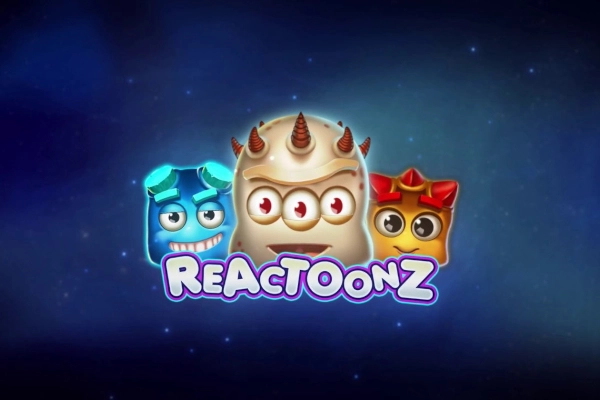
In short: Reactoonz is Play'n GO's 2017 alien grid slot: no paylines, just clusters of five or more on a 7x7 board that cascade and charge a meter. The meter, not a scatter, is what unlocks the big moments, including a giant wild that breaks apart over several cascades. It is built for players who enjoy chain reactions and do not mind a busy screen.
Clusters on a 7x7 grid
Released on 23 October 2017, Reactoonz drops 49 animated aliens onto a 7x7 grid. A win is five or more matching aliens touching horizontally or vertically. Winning aliens are teleported away, new ones fall in from above, and the spin keeps going for as long as fresh clusters form. Flux capacitors act as wilds.
Several smaller effects can fire inside any spin. Oversized aliens multiply the prize when they join a winning cluster. Four matching symbols in a square merge into a Giantoonz, which doubles the win it is part of. One random one-eyed alien is also marked as the fluctuating symbol each spin, and when marked aliens win they leave two wilds behind to keep the cascade going.
The Quantum Leap meter
Every winning cluster sends energy to the Gargantoon, the alien boss waiting beside the grid. Each time his meter charges, one of four Quantum features fires:
- Implosion turns three to six symbols into wilds and clears the symbols around them.
- Incision places a wild in the centre and cuts two diagonal lines of one random symbol through the grid.
- Demolition destroys every one-eyed alien and all matching symbols.
- Alteration picks one one-eyed alien type and turns all of them into another symbol.
Charge the meter fully five times and the Gargantoon himself lands as a 3x3 wild, covering nine of the 49 cells. When no more wins form, he splits into two 2x2 wilds and finally into nine single wilds, so one arrival can feed several cascades in a row. That is the game's headline moment, and it only comes from wins that have already happened.
The useful thing to watch in the free demo is how many cascades it takes to fill the meter, and what each Quantum feature actually changes on the board.
RTP, volatility and what is not published
The standard RTP is 96.51%. Play'n GO does not publish return figures on its own website, and operators can choose lower-RTP versions, so check the paytable inside the game before playing for real; why the same slot can have different RTP covers how that happens.
The volatility label depends on where you look: Ontario-regulated casinos describe it as medium in one case and high in another, and Play'n GO gives no official rating. Casino-quoted maximum wins also differ, which is why no top prize is shown in the specs. What the design does tell you is that the bigger results rely on wild-heavy chains, and those arrive unevenly.
Where it can drag
Four matching aliens pay nothing, so a crowded grid full of near misses can return zero. There is no traditional free spins round and no pick feature, and the Quantum features trigger from the meter rather than from any choice you make, so the middle of a session is more watching than deciding.
The screen is also busy. Wilds, fluctuating symbols, oversized aliens and Giantoonz can all reshape the grid in one spin, and the first few rounds can be hard to follow until each piece is familiar. Once it clicks, small cascades stop feeling like wasted spins because every one of them moves the meter.
Reactoonz 2
The 2020 sequel, Reactoonz 2, keeps the 7x7 cluster idea and adds a second meter: a Fluctometer that charges Electric Wilds, which in turn feed a Quantameter. It suits players who found the original too sparse between events; the first game remains the easier one to read.