
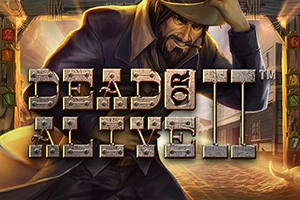
In short: Dead or Alive 2 is NetEnt's high-volatility Wild West slot, where a quiet nine-line base game leads to a choice of three free spins modes built around sticky wilds. The Train Heist mode carries a 100,000x ceiling, a very large figure for a slot without a jackpot. It is a game for patient players who accept long dry spells in exchange for a rare, very large result.
Nine lines and five outlaws
Dead or Alive 2 runs on five reels and three rows with 9 paylines, and was released on 23 April 2019 as the sequel to NetEnt's 2009 original. The wilds are five outlaws who substitute for all paying symbols. In the base game they are just wilds; in free spins they stick in place and, depending on the mode, turn into multipliers or extra spins.
Scatters pay on their own: two pay 2x the bet, three pay 4x, four pay 25x and five pay 2,500x. Three or more also start free spins. Three scatters pay only 4x, so the real value of a trigger is the round that follows; five scatters, worth 2,500x on their own, are the one base-game event that pays big by itself. The default stake range is 0.09 to 9, low by modern standards, and a feature buy exists in some markets.
Three modes, one decision
Free spins start with 12 spins and a choice of mode. NetEnt frames it as a choice of risk: the chance to win really big, or to win more often.
Old Saloon is the steadiest. Every win in the round is doubled, and wilds stick for the rest of the round. Two sticky wilds add five extra spins. It is the "win more often" end of the choice, and the easiest mode to judge after a few rounds.
High Noon Saloon turns wilds into multipliers. Two wilds on the same reel become Double Multiplier Wilds, and three become Triple Multiplier Wilds. Because they are sticky, a reel that fills early keeps multiplying every line it touches. A sticky wild on each of the five reels adds five spins.
Train Heist uses a progress bar that gains one step for each wild that lands. Each step adds 1x to the win multiplier, and a full bar of 16 steps means 16x and five extra spins. NetEnt ties the 100,000x maximum to this mode.
RTP, hit rate and the 100,000x figure
The RTP is 96.80% and the hit frequency 30%. NetEnt describes the game as high volatility, as does Evolution's catalogue, and the structure makes that obvious: the base game pays little, and most of the return sits in a feature that can vary enormously from one round to the next. Lower settings exist; why the same slot can have different RTP explains how to check.
The 100,000x figure appears in NetEnt's feature description and in Evolution's catalogue. NetEnt's summary panel shows a much lower 1,600x, which does not match its own text. The feature buy, where offered, has no published price.
How it compares with the original
The 2009 Dead or Alive also has 9 lines and 12 free spins with sticky wilds and doubled wins, much like Old Saloon, with a 96.82% RTP and an 8,600x top payout. The sequel keeps that core and adds the two riskier modes. Dead or Alive 3: Wanted is a separate 5x5 game.
Trying the three modes
The demo is the cheapest way to learn the modes. Try each one several times: Old Saloon to see how doubled wins add up, High Noon to see how often two or three wilds meet on one reel, and Train Heist to see how far the bar usually gets before the spins run out. A dozen rounds per mode gives a far better feel for the spread than any single bonus.
Long dry spells, by design
Free spins need three scatters on nine lines, and the base game can go a long time between them. Most rounds land far below the headline figure, and the 100,000x result depends on almost everything going right in one mode. The low maximum stake keeps each spin cheap, but it does nothing to shorten the wait. A single tense decision is the thrill here; a balance that moves steadily is not.